Hauptlinie 9: Niggli Ellenberger
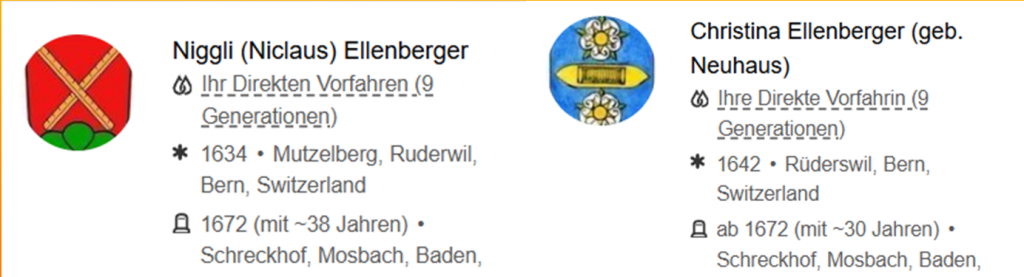
Niggli Ellenberger Taufeintrag
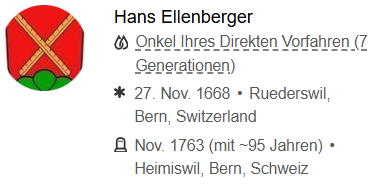
Nebenlinie 8 Hans Ellenberger (1668-1763):
zur Tochter Barbara Krehbiel/Küntzi/Krehbiel https://geschichten-weierhof.de/ins-neuhannese/
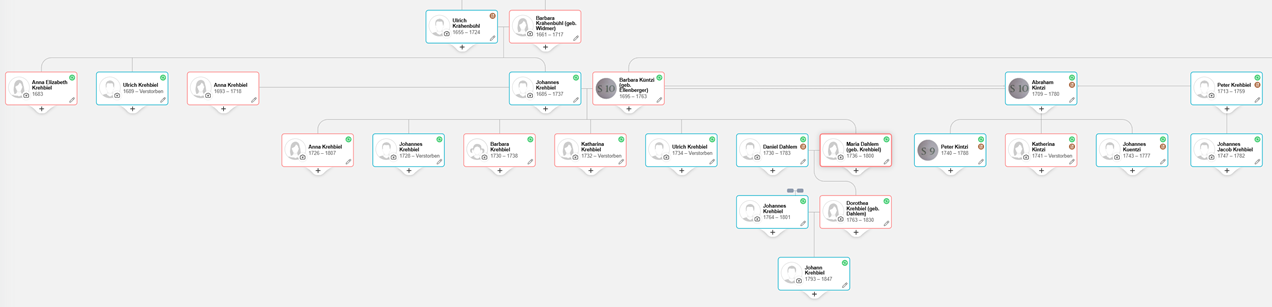
zu Hans Ellenbergers Sohn Johannes Ellenberger
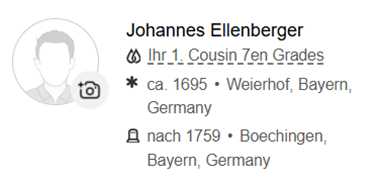
Hauptlinie 8: Nicolaus Ellenberger (1667-1724)
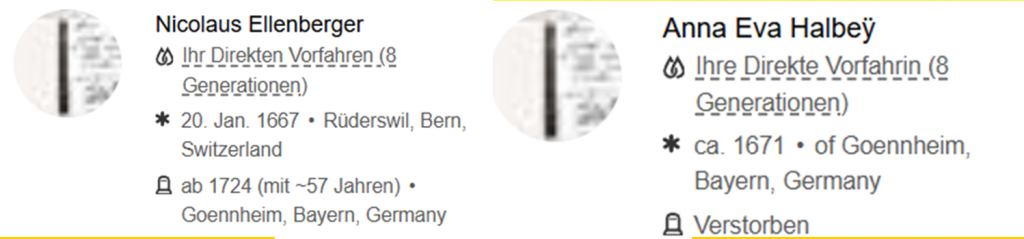
Taufeintrag Nicolaus Ellenberger
Hauptlinie 7: Abraham Ellenberger (1705-1798)
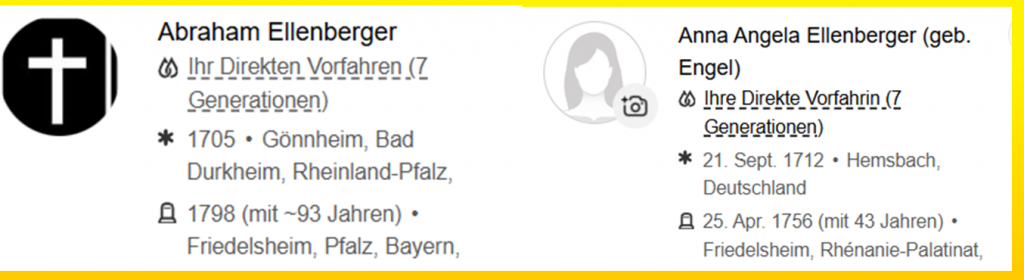
Urkunden Geburt, Heirat, Tod dringend gesucht!
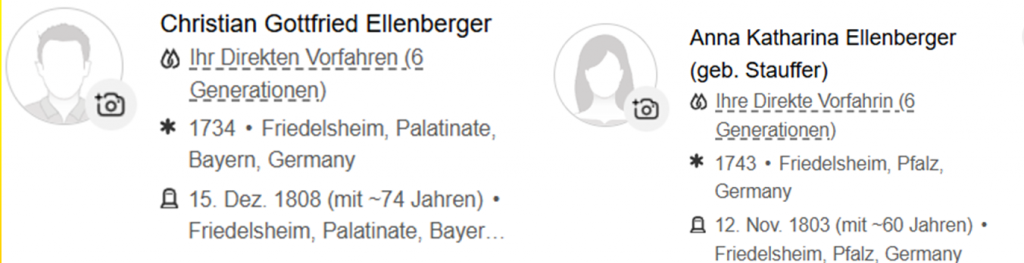
Hauptlinie 6: Christian (Gottfried) Ellenberger (1734-1808)
Urkunden Geburt, Heirat, Tod dringend gesucht!
A son of Christian Gottfried, Jürgen Heinrich Ellenberger, came from Gönnheim.
Jürgen Heinrich learned farming trades, worked in a general store, and apprenticed with a tailor. In 1812, he was elected preacher of the Mennonite congregations of Friedelsheim and Erpolzheim. In 1808, he married Elisabeth Hertzler of Alsheim. In 1824, he moved to Eppstein, where he served the congregation along with the congregation of Friesenheim. Elisabeth Hertzler died in 1828 at the age of 39, having borne him ten children. His second wife was Katharina Eicher, widow of Jakob Schowalter.
His father, Christian (Gottfried) Ellenberger, married to Katharina Stauffer, was a farmer and vintner in Gönnheim.
The Ellenberger family tree, published in 1995 in a larger work by Richard Warren Davis (Mennonite Research Center!), is shown below.
Christian Ellenberger, b. 1737. d. 15 Dec 1808, Friedelsheim. He was living with his father in 1759. He was living at Friesenheim in 1768. He was living at Wachenheim (Neustadt) with his wife and four sons in 1773. He married Catherina Stauffer (1743-11 Nov 1803) supposedly daughter of Christian Stauffer and Katherina. She died at Friedelsheim.
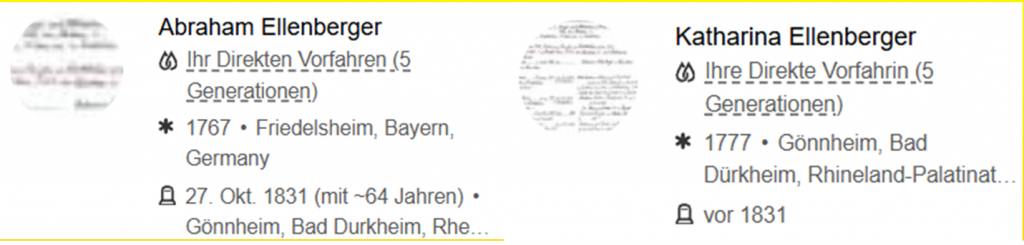
Hauptlinie 5: Abraham Ellenberger (1767-1831)
Urkunden Geburt, Heirat dringend gesucht!
Nebenlinie 5: Barbara Ellenberger (1794-1832)

Stammbaum Barbara Ellenberger mit allen Bezügen
Hauptlinie 4: Jakob Ellenberger (1800-1879)
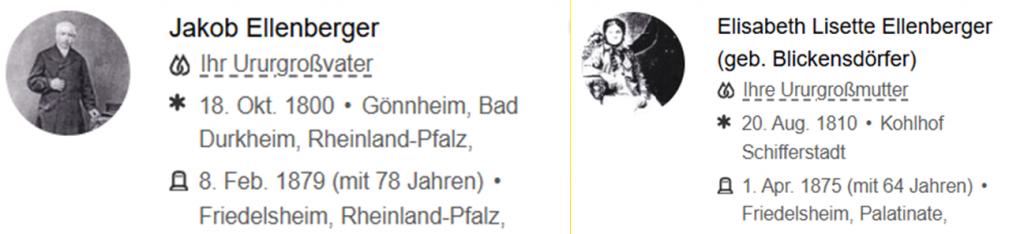
The Mennonites of Friedelsheim maintained their own school, presumably from a very early date. Around 1814, a certain Stübner was the teacher. From 1824 to 1827, the Mennonite children attended the village school, but in 1827 the congregation appointed Jacob Ellenberger as headmaster. In 1829, the school received state accreditation. From then on, it, like the village school, was subject to state and Protestant oversight. In 1869, Ellenberger had to retire due to age, and since then, the Mennonite children attended the village school but received their religious instruction from their own pastor.
In 1830, Ellenberger was also elected preacher, thus transforming the ministry in the congregation from lay preaching to full-time preaching. Another preacher who served with and before Ellenberger from 1825 to 1832 was Johannes Risser, a zealous and gifted man who also conducted missionary events. In 1832, he emigrated to America. His predecessors in office were… his uncle Heinrich Ellenberger (Friedelsheim, 1812-24), who moved to Eppstein and served as pastor of that congregation until he emigrated to America in 1850. The Erpolzheim congregation was closely connected to the Friedelsheim congregation, and the two congregations eventually merged into one. Its members also included the Mennonites from the surrounding villages—in addition to Gönnheim and Wachenheim, these included Dürkheim, Seebach, Hausen, Hardenburg, Grethen, Ungstein-Pfeffingen, Leistadt, Herxheim, and Friedelsheim. In 1843, the Mennonites from Dackenheim also joined this congregation. According to Frey, there were a total of 198 Mennonites in the area in 1834, 99 of them in Friedelsheim. Between 1803 and 1824, the Assenheim congregation also merged with this one. It is unknown when the Mennonites from Gronau or Alsheim joined this congregation, but presumably at the beginning of the 19th century. Mennonites had lived there since earliest times (see the Mennonite Lexicon I, 705, footnotes).
In 1833, the Kohlhof congregation near Schifferstadt merged with the Friedelsheim congregation, but retained a degree of autonomy and participated only in pastoral matters.
In 1861, financial cooperation was strengthened by the establishment of a “Menno Fund” on the 400th anniversary of Menno Simons’ death, in order to cover shared needs. The Mennonites of Kohlhof and Friedelsheim actively contributed to this fund. It made a valuable contribution to weaker congregations and grew to 30,000 marks before the hyperinflation of 1923. From 1857 onward, the Branchweilerhof congregation was also served once a month. However, this connection was only a personal one with Pastor Jacob Ellenberger. Jacob Ellenberger died in 1879 after a very active life as a pastor and teacher.
His nephew, Jakob Ellenberger II, who assumed his position in 1881, wrote his obituary under the title “Jakob Ellenberger, Teacher and Preacher of the Mennonite Congregation of Friedelsheim. A Biographical Sketch Based on His Handwritten Papers. With an Appendix of Some of His Poems” (Frankfurt, 1879). As a poet, he was also represented in the hymnal of the South German Mennonites with hymn number 226.
Jacob Ellenberger II served the congregation from 1881 until his death in 1901.
High-resolution historical photos from the Ellenberger genealogy can be purchased as a download: https://www.ellenberger.shop/pcat/fotos/
Hauptlinie 3: Daniel Adolf Ellenberger (1846-1889)
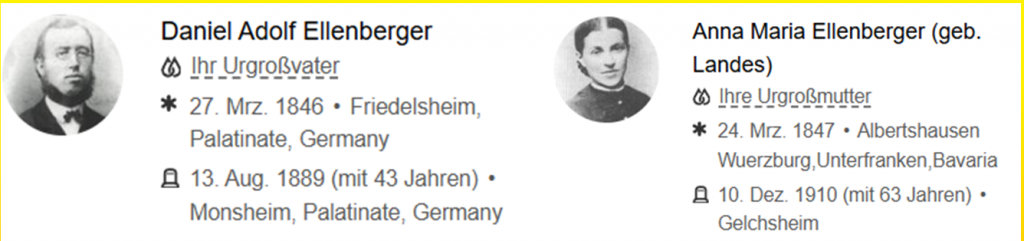
•Daniel Adolf studied theology at the mission house in Basel, where he met Michael Landes from Albertshausen. During a visit there, he met Michael’s sister Marie, whom he later married.
After Daniel’s early death, Anna Maria Landes moved to Gelchsheim to live with her sister Babette Horsch. In 1907, they moved to Würzburg to live with their son Jakob Heinrich, who taught there until her death.
•Prediger in Monsheim 1867-1889
•5 Kinder
–Jakob Heinrich (Großvater des Autors)
–Daniel Wilhelm Adolf
He lived in Bruckberg near Ansbach and, due to his father’s early death, had no opportunity to receive an education. As a teenager, he was sent to Bruckberg, a Christian institution for mentally and physically disabled men, because he suffered from epileptic seizures. These lessened and eventually stopped in Bruckberg, but he remained there as a helper. When Hitler took over Bruckberg, he moved to Thomashof, where he lived until his death. He remained unmarried.
–Anna Maria Lydia
–Clara Johanna Elisabeth Mueller > USA
–Selma Emilie
After her father’s death, she lived with her mother and sister Elisabeth on the Horsch farm in Gelchsheim near Würzburg. When Elisabeth went to the USA, she moved to Würzburg with her brother Jakob Heinrich. After her mother’s death, she also went to the USA and lived with her sister Elisabeth and her family. Unmarried.
Hauptlinie 2: Jakob Heinrich Ellenberger (1875-1943)
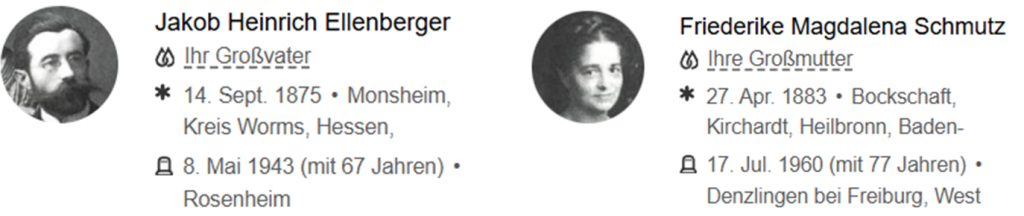
•As the eldest son of a preacher, he was allowed to attend the Weierhof school free of charge. Because he was already a student when his father died, he was permitted to continue his education and was the only one to receive a higher education. He taught as a senior teacher in Neustadt, Würzburg (where he lived for a time with his sister Selma and his mother), Rosenheim, and Munich. He was also active as a visual artist.
•Seine Kunstausstellung
Hauptlinie 1: Theodor Adolf Heinrich Ellenberger (1917-2010)
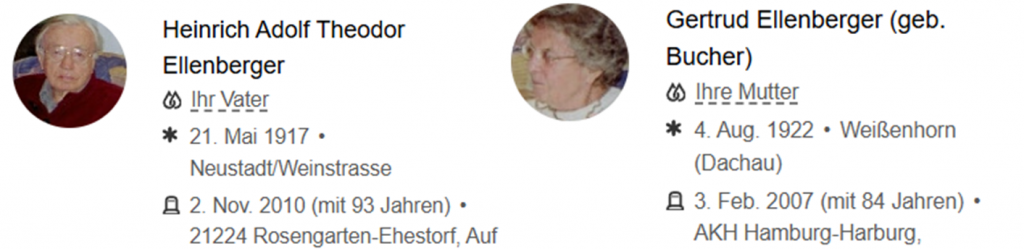
Theodor Adolf Heinrich was born in Neustadt an der Haardt (today: on the Wine Route) and moved to Rosenheim as a child. He studied physics in Munich and obtained a position as a teaching assistant after starting his family.
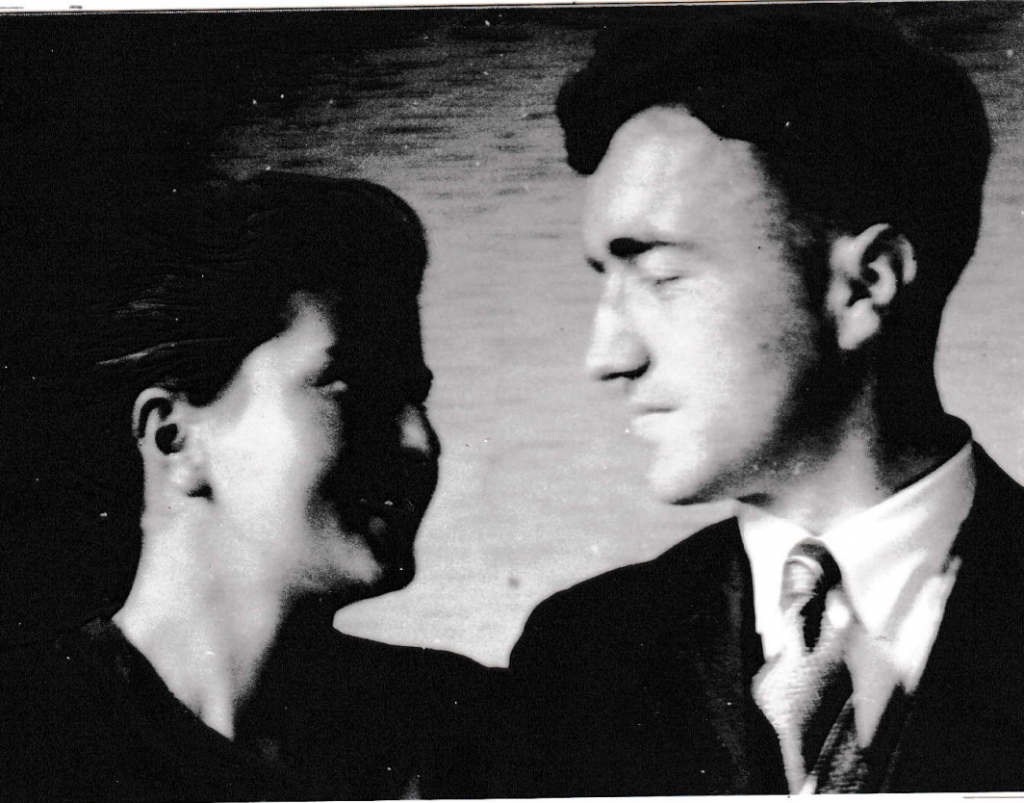
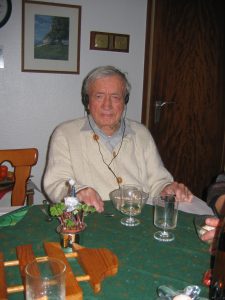
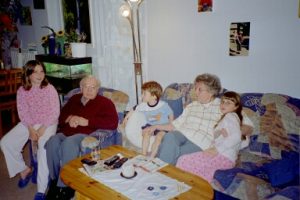
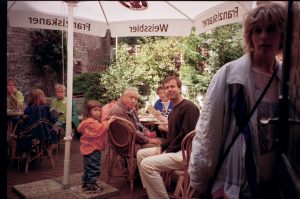
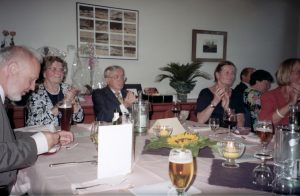
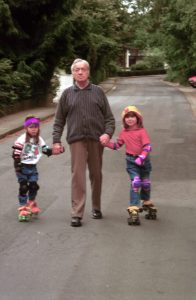
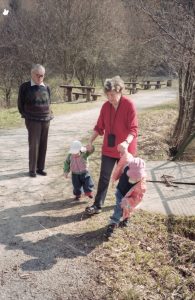
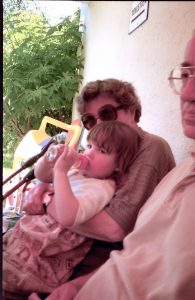
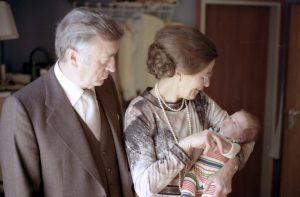
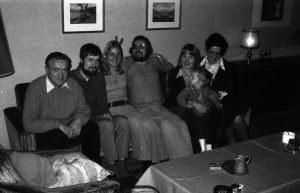
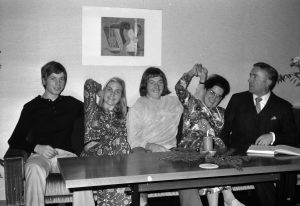
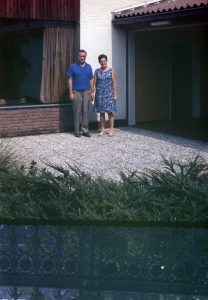
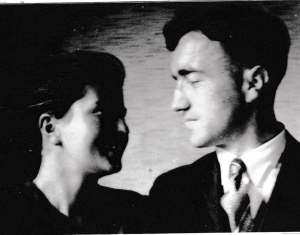
Hauptlinie 0: Wolfgang Ellenberger (*1955)
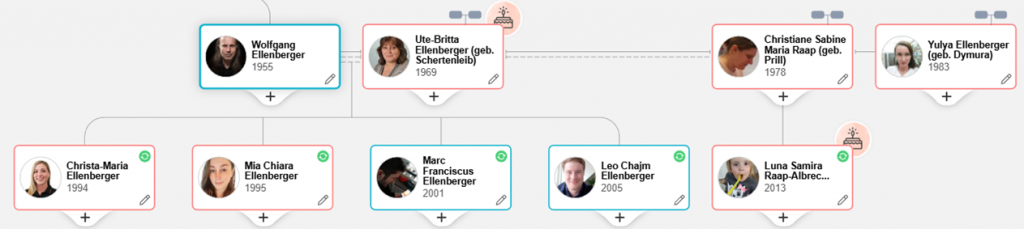
see also https://bio.ellenberger.me as multi-medial autobiography online.
sources:
Amelia Mueller – The Abraham Ellenberger Genealogy (1980)
Adolf Hertzler – Ellenberger Notizen – Dank an die Mennonitische Forschungsstelle!
RWD – Richard Warren Davis Ellenberger genealogy
And here you get the free download of the E4.0-Ellenberger-genealogy.
The most comprehensive approach is to open a free account at www.Myheritage.com and then visit my page.
If that doesn’t work, give me the link to your page or your email address, and I will send you an invitation to the site:
ttps://www.myheritage.de/family-sites/wolfgangellenberger/OYYV7FDZPG657D6D2SLLA7HSQCNNNEY